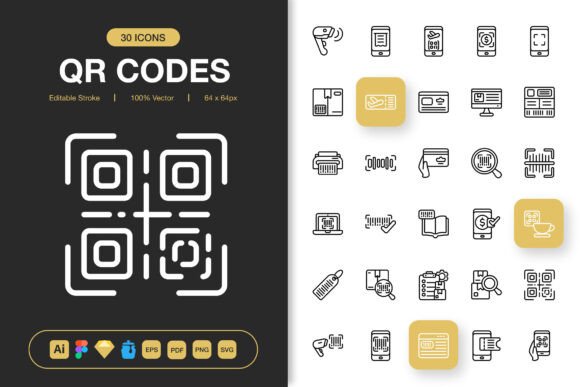
Revolutionize Your Visual Projects with a Professional QR Code and Barcode Icon Pack
In today’s fast-paced digital and physical design landscape, the visual elements you choose are foundational. They communicate function, enhance usability, and establish aesthetic credibility. For projects that involve digital connectivity, data capture, or inventory management, the symbols for QR codes and barcodes are indispensable. Yet, sourcing high-quality, consistent icons for these elements can be a fragmented and time-consuming chore. This is where a dedicated, comprehensive QR Code and Barcode Icon Pack becomes not just a convenience, but a strategic asset.
Why a Dedicated Icon Set Matters for Modern Design
Think about the last project where you needed a barcode icon for a retail app interface, or a QR code symbol for a promotional flyer. Perhaps you searched free repositories, piecing together icons of varying styles and quality. The result can be a visually inconsistent project that feels amateurish. A professionally crafted icon pack solves this by providing a set of high-quality icons designed under a unified visual philosophy. This cohesion is critical. When users encounter your icons across different touchpoints—a website, a mobile app, a printed poster—they should experience a seamless visual language. This builds trust and improves comprehension.
Minimalist icon design, a hallmark of modern aesthetics, is particularly powerful. It strips away unnecessary detail to focus on pure function and form. This clarity ensures icons remain legible at small sizes on mobile screens while still being impactful on large posters. A minimalist QR Code and Barcode Icon Pack delivers this versatility, making it perfect for the vast spectrum of contemporary media.
The Universal Application of a Quality Icon Pack
The true value of a robust icon set lies in its adaptability. Let’s explore the specific arenas where these icons can elevate your work:
- Digital Interfaces: Websites and mobile apps require crisp, scalable icons for buttons, feature explanations, and settings menus. Icons representing "scan a QR code" or "view barcode" are common in e-commerce, logistics, and event apps.
- Print and Physical Media: Books, infographics, flyers, banners, and posters often use icons to visually summarize concepts. A clean barcode icon can indicate a product section; a QR code symbol can invite interaction without cluttering the layout.
- Social Media & Marketing: Graphics for posts or ads benefit from quick-to-recognize icons that guide user action, such as directing them to a link via QR code.
- Corporate Communications: Internal documents, presentations, and reports gain professionalism with standardized icons for processes involving tracking or digital verification.
Having one source for all these scenarios streamlines your workflow enormously. Instead of adapting a different icon for each medium, you pull from the same trusted pack, ensuring brand and project consistency everywhere.
Dissecting the Essential Features of a Professional Pack
Not all icon packs are created equal. When selecting a QR Code and Barcode Icon Pack, certain features are non-negotiable for professional use. They transform the pack from a static collection of images into a dynamic, integrable resource.
Core Technical Features for Flexibility
Editable Stroke: This is a game-changer. Icons with editable strokes mean the line weight, corners, and endpoints can be modified directly within vector editing software. You can adjust the icon to match the exact line style of your project’s existing design system without having to redraw anything. It provides perfect harmony.
High Quality & 100% Customizable: "High quality" implies precision drawing with clean paths, balanced proportions, and thoughtful geometry. "100% customizable" extends beyond color changes. It means you can deconstruct, recolor, combine, or alter components without loss of quality, allowing the icons to become a foundational part of your unique designs.
Easy Drag and Drop: This speaks to workflow efficiency. Well-organized files allow designers to simply drag the needed icon from a library window directly into their working document, saving precious seconds that accumulate over a project’s lifetime.
The Critical Importance of Multiple File Formats
The inclusion of specific file types is what makes an icon pack truly universal. Each format serves a distinct purpose in the design ecosystem:
- Source File (Adobe Illustrator): The master, fully editable vector file. This is the starting point for deep customization.
- Figma File & Sketch File: Direct integration for the dominant UI/UX design tools. This allows teams working in these platforms to use the icons natively without conversion.
- Iconjar File: A dedicated icon management format that keeps your library organized and accessible across various applications.
- EPS Version 10 & SVG File: Universal vector formats compatible with a wide range of software, from print-focused Adobe InDesign to web development environments. SVG is essential for modern web implementation.
- PDF File: Useful for quick viewing, sharing with clients, or placement in certain page layout contexts.
- PNG Transparency (Multiple Sizes): Pre-rendered bitmap files at key resolutions (32px, 48px, 64px, 96px, 128px, 256px, 512px) are vital for developers and for scenarios where a quick, rasterized asset is needed. The multiple sizes ensure you have the right resolution for any screen density or print requirement.
- Readme.txt: A simple but crucial file that outlines usage, licensing, and file structure, ensuring you can get started without confusion.
This multi-format approach means the QR Code and Barcode Icon Pack is ready for any toolchain, whether you’re a print designer in Illustrator, a UI designer in Figma, a web developer using SVGs, or a marketer needing PNGs for a social media template.
Integrating the Icon Pack into Your Real-World Workflow
Adopting a comprehensive icon set changes how you approach projects. Imagine starting a new design for a warehouse management app. Instead of brainstorming how to represent "scan inventory," you immediately open your icon pack library. You select a clean, minimalist barcode icon. Because it’s vector-based and editable, you match its stroke width to your app’s existing UI elements. You then drag the adapted SVG directly into your Figma prototype. For the marketing campaign supporting the app, you use the same icon’s 256px PNG version in your digital banners and its EPS version in the printed brochures. One asset, perfectly consistent, across every medium.
This efficiency reduces decision fatigue and production time. It also elevates the final product. The icons carry a professional weight, communicating that your project is polished and thoughtfully assembled.
Key Considerations Before Choosing Your Pack
When evaluating a QR Code and Barcode Icon Pack, focus on these practical factors:
- Style Compatibility: Does the minimalist design align with your or your client’s overall brand aesthetic? Review the icon style against your existing visual assets.
- Format Coverage: Does it include all the file types you and your team actually use? If you work exclusively in Sketch, ensure the Sketch file is present and well-structured.
- License and Usage: Always check the licensing terms through the readme or documentation. Confirm it covers your intended use cases—commercial projects, client work, etc.
- Scope of the Set: Does the pack offer a sufficient variety of QR code and barcode representations? Look for different states (e.g., static, scanning animation frame) and related symbols (like a smartphone scanning) to cover various narrative contexts.
By addressing these points, you ensure the icon pack becomes a seamless, long-term addition to your design toolkit, rather than a temporary fix.
The Broader Impact on Design Consistency and Efficiency
Ultimately, investing in a specialized, high-quality icon pack is an investment in your design process’s integrity and speed. The QR Code and Barcode Icon Pack described here, with its editable strokes, multitude of file formats, and minimalist approach, is engineered to fit directly into contemporary, multi-platform design workflows. It removes the friction of asset creation for these specific, vital symbols, allowing you to concentrate on the larger creative challenges of your projects. From the micro-interactions on an app screen to the broad visuals of a city-wide poster campaign, having these reliable, versatile icons at your fingertips empowers you to execute with confidence and cohesion. Your next projects, indeed, stand to be transformed.