Evaluating Drummer and Drum Kit Musician Vector Illustrations for Professional Creative Work
Finding well-crafted, adaptable visual assets for projects involving music, performance, or rhythm-based themes often means sifting through countless generic options. The Drummer and Drum Kit Musician AI EPS illustration collection enters this space as a specialized resource designed to address specific workflow needs. Rather than offering a few scattered icons, it presents a cohesive set built around a single thematic focus, which can simplify asset selection when consistency matters across a website, print piece, or application interface.
What immediately distinguishes this particular collection is the attention given to file architecture and editability. Many vector packs deliver usable graphics but require tedious reorganization before they fit into a professional pipeline. Here, the promise of neatly organized files and layers carries practical weight for anyone who has spent time untangling poorly named groups or hunting through unlabeled artboards. Whether you work on macOS or Windows, the cross-platform compatibility reduces friction before the creative work even begins.
What the Collection Actually Contains
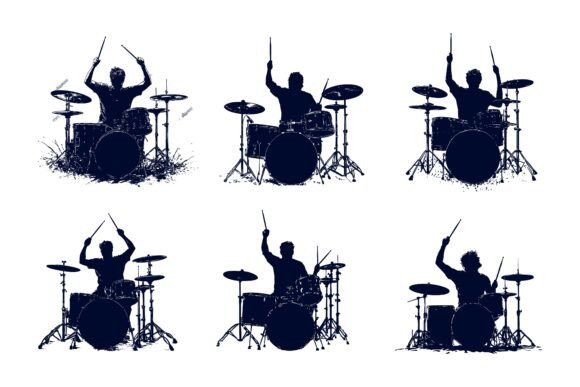
At its core, the Drummer and Drum Kit Musician set provides vector illustrations depicting drummers, drum kits, and related musical elements. The inclusion of AI (Adobe Illustrator), EPS, and JPG formats means you receive both fully editable source files and ready-to-use raster versions. This multi-format approach acknowledges that different stages of a project demand different file types. A designer building a poster in Illustrator needs native vector control, while a blogger pulling together a quick social media graphic may only need a high-resolution JPG.
The illustrations themselves appear built with a clear understanding of detail and proportion. Drum kits, when rendered poorly, can look like an indistinct collection of circles and lines. Here, the components—kick drum, snare, toms, hi-hat, cymbals—read as recognizable instruments, and the drummer figures carry natural posture and movement. This matters because music-related visuals often fail when the instrument doesn't look correct to an audience that includes actual musicians and attentive fans.
Structural Quality and Layer Organization
One of the more underappreciated aspects of illustration sets is how they are built behind the scenes. The mention of a neatly organized file and layer structure isn't a minor feature—it's a significant usability advantage. When you open an AI or EPS file and find clearly named layers, grouped objects, and logically separated elements, the editing process accelerates considerably. You can isolate a specific drum, change the color of a cymbal, or adjust the drummer's arm position without accidentally selecting unintended pieces of the artwork.
This structural discipline also supports long-term value. A file you purchase today might need modification six months from now for a different client or campaign. Returning to a well-organized document saves you from having to reverse-engineer your own past work or, worse, buying new assets because the old ones became too cumbersome to adapt.
Flexibility Across Media and Platforms
The Drummer and Drum Kit Musician collection is positioned as suitable for print, web, symbols, apps, and infographics. This breadth isn't automatic for all vector packs. Print applications demand clean outlines, proper scaling behavior, and color accuracy in CMYK environments. Web and app use requires assets that remain crisp at multiple resolutions and can integrate smoothly into interface designs. Infographics rely on visuals that simplify complex ideas without losing meaning.
The ability to edit colors and modify icons easily—a stated strength of this set—directly supports this cross-media adaptability. A drum kit that works as a dark silhouette in a printed brochure might need to become a light, outlined symbol in an app navigation bar. Having source vector files means you can make these adjustments without quality loss, and the organized structure means you can do it efficiently.
Real-World Applications and Audience Fit
Several professional groups stand to gain practical value from this illustration set. Consider the following scenarios:
- Music educators and content creators building lesson materials, course slides, or tutorial graphics benefit from consistent, clear instrument illustrations that students recognize instantly.
- Event promoters and venue owners designing posters, social media announcements, or ticket artwork for live performances can use the drummer imagery to signal genre and atmosphere without licensing photographs.
- App and web designers working on music-related platforms—lesson booking systems, band finder tools, instrument marketplaces—need interface icons and spot illustrations that don't feel generic.
- Bloggers and publishers covering music gear reviews, rhythm technique articles, or band interviews can break up text with relevant visuals that maintain a publication's visual standards.
- Small business owners in the music instruction or instrument retail space building marketing collateral benefit from editable assets that adapt to seasonal promotions or rebranding efforts.
What ties these use cases together is the need for reliability and consistency. When a drum kit appears in multiple places across a brand's materials, small inconsistencies become noticeable and can subtly undermine the professional impression. A unified illustration set helps avoid this fragmentation.
Evaluating Detail Consistency and Visual Polish
Illustration sets sometimes suffer from quality drift—where early pieces in a collection show careful attention, but later ones appear rushed or stylistically mismatched. The emphasis on perfection in details and consistency suggests a deliberate approach to maintaining uniform line weights, shading styles, proportions, and overall aesthetic coherence throughout the Drummer and Drum Kit Musician collection.
From a professional standpoint, consistency isn't merely cosmetic. It affects how audiences perceive the credibility of the content these illustrations support. A music lesson platform that uses mismatched instrument graphics looks less authoritative than one with visually cohesive elements. Similarly, an event flyer mixing flat icons with highly detailed illustrations can confuse the visual hierarchy and weaken the intended message.
Editable Components and Customization Potential
Perhaps the most practical value in this set lies in its editability. The ability to change colors means you can adapt the illustrations to match existing brand palettes without needing to recreate them from scratch. Modifying icons allows you to emphasize different aspects of a drum kit or drummer pose depending on context. This flexibility extends the usable life of the assets across multiple projects and reduces the need for additional purchases.
Consider a scenario where a drum school uses the illustrations across its website, printed brochures, and in-studio signage. The web version might use the school's primary blue palette, the brochure could shift to grayscale for cost-effective printing, and the signage might need enlarged, simplified versions of select kit components. Having editable source files makes these transformations straightforward rather than requiring separate assets for each application.
Technical Compatibility and Workflow Integration
The explicit support for both Mac and Windows environments addresses a practical concern that sometimes goes overlooked. Design teams often work across operating systems, and freelance creatives may collaborate with clients using different platforms. Ensuring that AI and EPS files open correctly regardless of the system eliminates a common point of friction.
Additionally, EPS format retains strong compatibility with older software versions and alternative vector editing programs beyond Adobe's ecosystem. If a team member uses CorelDRAW, Affinity Designer, or Inkscape, the EPS files typically import with fewer issues than proprietary formats. This forward-thinking approach to file delivery respects the reality of diverse creative toolchains.
Potential Limitations to Consider
While the collection offers substantial strengths, realistic evaluation requires acknowledging where it may not fit every need. The illustrations focus specifically on drummers and drum kits, which means anyone seeking broader music-themed graphics—guitars, keyboards, brass instruments—would need to supplement with additional resources. The stylistic approach of the set may also lean toward a particular aesthetic that, while versatile, won't suit every brand identity or project mood.
Additionally, while editable vector files provide maximum flexibility, users without experience in Adobe Illustrator or similar vector editing software may find the learning curve for advanced modifications steeper than expected. For basic color changes, the process is typically straightforward, but reshaping elements or creating composite images from multiple illustrations requires intermediate design skills.
Comparing the Value Proposition
When evaluating illustration sets for professional use, the calculation involves more than upfront cost. Time saved through organized files, versatility gained through editability, and consistency maintained across touchpoints all contribute to the practical return. The Drummer and Drum Kit Musician collection appears built with these factors in mind, prioritizing the behind-the-scenes quality that affects daily usability.
For designers and content producers who frequently work with music-related themes, having a dedicated, reliable drum illustration set on hand can shorten project timelines and raise output quality. Rather than starting from scratch or patching together disparate free resources of varying quality, you begin with a coherent visual foundation that you can adapt rather than rebuild.
Practical Recommendations Based on Use Case
Before adding this collection to your asset library, consider your typical projects. If you regularly produce materials that would benefit from drummer imagery—event graphics, educational content, music app interfaces, editorial illustrations—the organized structure and editability likely justify the investment. If your music-related work is infrequent, you might weigh whether a more general illustration library covering multiple themes serves you better in the near term.
For those working in music education marketing, the consistency factor alone carries significant weight. Prospect students and their families notice visual polish, even if subconsciously. A drum school website with clean, professional illustrations communicates attention to detail that extends to the perceived quality of the instruction itself. In competitive local markets, these subtle signals can influence enrollment decisions.
How the Assets Perform Under Real Work Conditions
Testing illustration sets under actual deadline pressure reveals their true value. When a client requests last-minute changes to event materials, the ability to quickly recolor drum kit elements, resize without pixelation, and export in multiple formats without hunting through disorganized layers makes a tangible difference. The structural investments made during asset creation—proper grouping, clear naming, logical hierarchy—pay off in moments of time pressure.
The inclusion of JPG files alongside vector formats also supports rapid deployment. A social media manager who doesn't need to edit the illustrations can grab a ready-made JPG, crop as needed, and publish without opening design software. This dual-track utility makes the collection relevant to both design professionals and marketing generalists within the same organization.
Ultimately, the Drummer and Drum Kit Musician illustration set represents a focused resource for a specific creative need. Its practical strengths in organization, editability, cross-platform support, and visual consistency position it as a useful addition to the toolkits of designers, educators, marketers, and content creators whose work regularly intersects with drum and percussion themes. By evaluating your own project patterns against what the collection offers, you can determine whether this specialized asset set aligns with your workflow and creative goals.