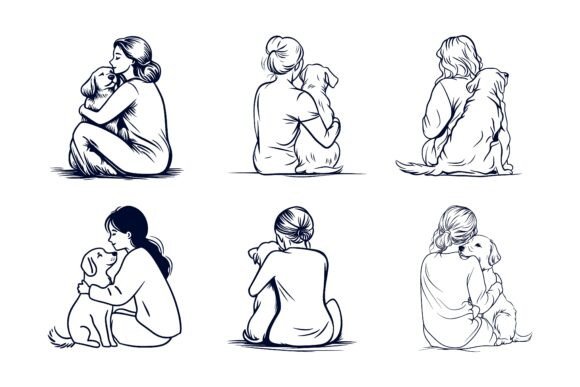
Person Hugging Their Dog: A Heartwarming Vector Illustration That Works Smarter, Not Harder
You found a drawing of a person hugging their dog. It speaks to you instantly—the relaxed shoulders, the canine smile, the quiet comfort in that embrace. You think: This belongs on my website banner, my pet-sitting flyer, or my vet clinic app icon. But before you drag a file onto your artboard, pause. The difference between a pixelated disappointment and a crisp, endlessly tweakable asset often hides in the technical details no one reads until it’s too late. The Person Hugging Their Dog illustration from our special AI EPS collection solves many of those headaches before they start—if you know what to look for.
I’ve seen marketers grab a pretty JPEG and stretch it to poster size, only to see a blurry mess. I’ve watched small business owners buy an “editable” file that came flattened into one ungroupable layer. These aren’t rare oversights; they’re everyday shortcuts that steal your time and dull your final piece. Let’s walk through what makes this particular set different, where people commonly slip, and how a little upfront checking keeps your project feeling polished, professional, and genuinely yours.
Why a Person Hugging Their Dog Connects So Deeply
Illustrations of human-animal bonds aren’t just cute—they tap into universal feelings of loyalty, care, and emotional support. Pet brands, adoption campaigns, veterinary services, mental health blogs, and even internal HR portals use such imagery to soften messages and build instant empathy. When you choose the Person Hugging Their Dog scene, you’re selecting a visual shorthand for trust. It works as a hero image, a social media post, a sticker, an infographic element, or a mobile menu icon. The key is making sure that emotional punch doesn’t get watered down by poor resolution or rigid coloring that fights your brand palette.
Mistake One: Settling for a File That Locks You In
Many people assume “an EPS is an EPS” and that any vector file will let them change the hugger’s shirt from teal to navy in two clicks. That’s not always true. Some designers flatten everything into a single compound path or export a raster JPEG embedded inside a vector wrapper. You open it, try to select a sleeve, and nothing separates. The result? You either waste hours reconstructing shapes, pay a freelancer to rework it, or use the artwork in a color that clashes with your logo.
With this Person Hugging Their Dog set, the layer structure is deliberately organized. Arms, ears, fur patches, the dog’s tail, the background—each lives on its own named layer or group. When you open the AI or EPS file in Illustrator, Affinity Designer, CorelDRAW, or even free tools like Inkscape, you can isolate exactly what you need. Change the collar color. Adjust the hair highlight. Remove the background altogether. A neatly layered file isn’t a luxury; it’s what saves you from a 20-minute edit turning into a three-hour ordeal.
Mistake Two: Ignoring Your Real Output Requirements
People often download a graphic for a social media post and later wonder why it can’t go on a flyer without fuzziness. That’s the difference between raster and vector, but it’s also about having both formats ready so you don’t have to convert at the last minute. A JPG preview helps you quickly see what you’re getting without launching a heavy design program, and the AI/EPS originals give you infinite scaling—from a tiny smartwatch screen to a trade show booth backdrop.
The Person Hugging Their Dog collection includes both. The JPG is perfect for a drag-and-drop blog image or a quick WhatsApp share with your team. The AI and EPS files ensure the curve of the dog’s ear remains smooth at 400%. If you’re building a responsive web page, you can export multiple SVG or PNG sizes from the source vector without ever touching the original. Think about all the places you might reuse the graphic: print materials like business cards and posters, digital banners, app splash screens, infographic callouts. Committing to a file bundle that covers print, web, symbols, and apps at once prevents the “wrong format” panic when a printer asks for 300 DPI CMYK while your only file is a tiny RGB screenshot.
Mistake Three: Overlooking Cross-Platform Editing Realities
Not everyone works on the latest macOS with Adobe Creative Cloud. Some use Windows, some use Linux, some rely on Canva’s upload system or open-source software. If a file was saved in a proprietary AI format with effects that only render on one operating system, you’re in trouble. This collection was purposefully built for both Mac and Windows users. The EPS format is universally readable, and the AI file is saved with compatibility in mind. You won’t open it to find missing fonts or linked images that broke because the designer used a temporary directory. The self-contained structure means you get what you paid for on day one, regardless of your setup.
Mistake Four: Assuming “Editable” Means “Effortless Without Guidance”
Even with a well-organized file, users sometimes click randomly, delete a path, or recolor by paint bucket instead of global swatches, which can leave odd edges. Here’s a better approach: before you start modifying, duplicate the original layer and lock it. That untouched reference sits safely at the bottom. Then, if you accidentally warp the dog’s paw, you can snap back. Also, look for consistent stroke widths and corner styles. In this Person Hugging Their Dog illustration, the details are built with precision—consistent line weights, aligned nodes, no broken paths. That level of craftsmanship means you can scale, recolor, and even apply basic transformations without the artwork breaking apart. If you’re a beginner, you’ll feel less nervous experimenting because the foundational vectors are solid.
Mistake Five: Sketchy Licensing That Limits Your Creativity
A significant frustration I hear from entrepreneurs: they buy a graphic, use it in a paid product, and a month later get a copyright warning. Not all illustrations labeled “for commercial use” are equal. Some restrict modifying the colors; others forbid embedding in a logo. Before you drop the Person Hugging Their Dog image into a logo mark, a T-shirt design, or a SaaS product interface, read the license terms. Our collection is meant to be broad—you can edit it, change colors, and adapt it easily. The whole point of a fully editable vector set is that you can reshape it until it fits like it was custom-drawn. You’re not just paying for a picture; you’re paying for the permission to make it yours without second-guessing.
How Poor File Choices Hurt Your Brand and Budget
Let’s say you run a small pet bakery and you need a friendly visual for your loyalty card. You grab a freebie JPEG online, force it into Canva, and print 500 cards. The image looks jagged, the colors don’t match your palette, and the card feels homemade in a bad way. You’ve spent money on printing and lost an opportunity to look trustworthy. Now contrast that: you download the Person Hugging Their Dog vector, open it, and with a few clicks adjust the person’s apron to match your brand orange, refine the dog’s fur to echo your golden retriever silhouette, and export crisp CMYK files. The printing looks intentional. The emotional connection is stronger. The design reinforces your brand rather than undermining it. A small upfront decision about file quality ripples into customer perception for months.
Practical Checks Before You Download or Use the Artwork
Next time you’re evaluating an illustration bundle, run through a quick quality checklist. First, does the preview display consistent line art and clean shading, or does it look like a rough auto-trace? In the Person Hugging Their Dog set, the line quality is even, the fills are solid, and the expression on both dog and human feels deliberately drawn, not algorithmically generated. Second, ask for or inspect a sample layer panel if possible—named groups, logical stacking, no random Clip Groups. Third, verify the file formats: AI and EPS for editing, plus at least one high-res raster for immediate use. Fourth, confirm that color changes are straightforward; look for global color swatches or simple flat fills. Fifth, check if the artwork handles both light and dark backgrounds without haloing artifacts. This particular set’s details remain clear whether you place it on a white website section or a dark-themed app screen.
Bringing the Art to Life in Real Projects
I recently helped a dog trainer design a workshop sign-up page. She wanted something that felt like a warm welcome. The Person Hugging Their Dog graphic sat perfectly beside the headline. We changed the human’s hair to match her customer demographic, swapped a couple of accent colors to match her brand, and removed the background so the image blended seamlessly with the page. Because the file was layered and organized, the whole customization took under ten minutes. She later used the same graphic, recolored for winter, on a holiday e-card. That kind of reuse finally makes an illustration purchase feel like an asset, not a single-use expense.
The “So What Are You Waiting For?” Reality Check
I understand the hesitation. Maybe you’ve been burned by clunky clipart before. Maybe you’re not a designer and worry about breaking the file. But when a product is built to reduce friction—neatly organized layers, cross-platform compatibility, built-in JPG reference, and true editability—the risk drops considerably. The absolute worst mistake is letting hesitation keep your project stuck in placeholder mode while a heartwarming, high-quality image sits unused. You don’t need to be an Adobe expert. Start small: open the file, click around the layers, change one color, and export a test PNG. You’ll see the structure immediately. From there, confidence grows, and so does the speed of your creative work.
If you’re preparing a presentation for a nonprofit adoption event, designing a pet-sitting app, or simply want to wrap your brand in warmth, the Person Hugging Their Dog illustration gives you both the feeling and the functional control. Skip the gamble of half-baked downloads. Choose a file that’s ready to work as hard as you do—and that actually stays beautiful no matter how many times you resize or recolor it.