Essential Design Assets: Understanding the Value of Government and Education Buildings Illustration Sets
In visual communication, the ability to represent civic architecture and learning environments carries significant weight. A well-crafted Government and Education Buildings Set provides designers, educators, and communicators with ready-to-use visual elements that capture the essence of public institutions, courthouses, schools, libraries, and administrative centers. These illustration collections have become indispensable tools across multiple industries, from urban planning presentations to educational publishing and digital interface design.
The strength of these specialized illustration sets lies not simply in their aesthetic appeal but in their structural organization and technical flexibility. When a collection arrives with AI, EPS, and JPG formats neatly organized with thoughtful layer structures, it removes friction from the creative workflow. This combination of vector precision and raster convenience means the assets perform reliably across print materials, web platforms, mobile applications, and large-scale infographics.
The Architectural Language of Civic Spaces
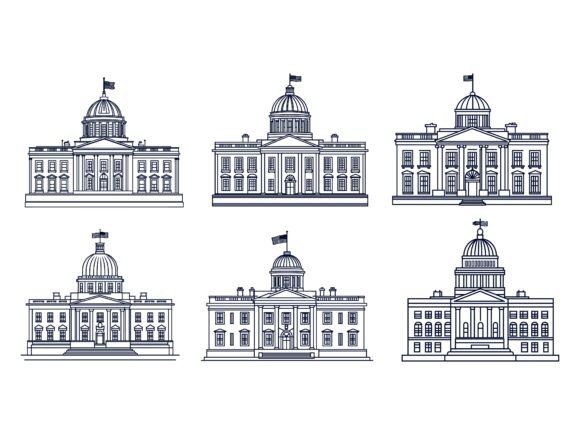
Government and education buildings carry distinct visual signatures. Colonnades, symmetrical facades, clock towers, pediments, and formal entrances communicate authority, permanence, and institutional trust. Educational structures often incorporate elements like bell towers, wide staircases, campus greens, and modern classroom wings that evoke growth, knowledge, and community. A comprehensive Government and Education Buildings Set translates these architectural characteristics into clean, scalable illustrations that retain recognizability without unnecessary complexity.
Designers working on municipal websites, school district materials, or public service announcements benefit from having these visual references immediately accessible. Rather than sourcing individual photographs or commissioning custom illustrations, they can pull from a cohesive collection where all buildings share a consistent visual language. The consistency matters because it creates visual harmony across projects, reinforcing brand identity for government agencies or educational institutions that need to present a unified public face.
Why Vector Format Matters for Institutional Design
The inclusion of AI and EPS formats speaks directly to the needs of professionals who require precision editing capabilities. Vector illustrations allow infinite scaling without quality degradation, making them suitable for everything from a small mobile app icon to a large exhibition banner. When a school district needs to resize a building illustration for both a smartphone app and a building-sized welcome sign, vector assets eliminate the need for multiple versions.
Layer organization within these files represents an often-overlooked advantage. Neatly organized file and layer structures mean individual elements within a building illustration can be isolated, recolored, or modified without affecting surrounding components. A designer working on a government portal might need to adjust the color of a courthouse dome to match specific branding guidelines. With properly structured layers, this task takes seconds rather than requiring extensive reconstruction of the illustration.
Applications Across Professional Contexts
The versatility of building illustration sets extends far beyond obvious use cases. Urban planners incorporate these visuals into community consultation materials, helping residents understand proposed developments within the context of familiar civic architecture. Educational publishers use school building illustrations in textbooks and digital learning platforms, creating consistent visual environments for young learners. Nonprofit organizations leverage government building imagery in advocacy materials to strengthen the connection between their causes and policy environments.
Infographic designers find particular value in these collections. When illustrating data about public spending, educational enrollment trends, or civic engagement metrics, the ability to place statistics alongside recognizable building types creates immediate contextual understanding. A chart showing school funding allocations becomes more impactful when paired with illustrations of the facilities those funds support. The Government and Education Buildings Set provides this contextual layer without requiring custom illustration work for each project.
Digital Interface and User Experience Considerations
Modern web and application interfaces increasingly rely on iconography and illustration to guide user navigation. Government service portals, school registration systems, and public information platforms benefit from building illustrations that help users quickly identify relevant sections. A courthouse icon leading to legal resources or a school building marking the education section creates intuitive wayfinding that text alone cannot achieve.
The cross-platform compatibility emphasized in these collections, with designs created for both Mac and Windows users, ensures that teams working across different operating systems encounter no technical barriers. This compatibility extends to the software ecosystems common in government and educational institutions, where standardized tools must function reliably regardless of the underlying platform.
Customization and Creative Control
The ability to edit illustrations, change colors, and modify icons according to specific needs transforms a standard asset collection into a genuinely flexible resource. Municipal branding often involves strict color palettes tied to city identity, while school districts frequently use colors associated with their athletic programs or founding traditions. The capacity to recolor building illustrations to match these established guidelines means the same base assets can serve diverse institutional identities.
Consider a scenario where a state government needs illustrations for all county courthouses across its jurisdiction. Rather than commissioning unique artwork for each location, designers can start with base courthouse illustrations from the set and modify architectural details, color schemes, and surrounding elements to reflect regional variation. This approach balances consistency with customization, delivering efficiency without sacrificing distinctiveness.
Print Production and Publication Standards
Print materials impose specific technical requirements that raster-only assets cannot always satisfy. Brochures, annual reports, signage, and educational workbooks demand crisp output at various sizes and on different paper stocks. The JPG format included alongside vector files provides convenient preview and placement options, while the AI and EPS formats deliver the production-ready quality required for professional printing.
Educational publishers producing textbooks or classroom materials benefit from illustration sets that maintain quality through the rigorous production process. Details like window mullions, rooflines, and entrance steps must remain sharp whether the illustration appears at quarter-page size or as a full-page spread. The attention to detail and consistency emphasized in well-crafted building sets ensures these quality standards are met across all output formats.
Workflow Integration for Teams and Individuals
Freelance designers juggling multiple client projects appreciate assets that integrate smoothly into existing workflows. A neatly organized file structure means less time spent searching for specific building types or variants. When a deadline looms for a school board presentation, the ability to quickly locate and customize an appropriate educational building illustration can make the difference between meeting and missing delivery timelines.
Larger creative teams within government communications departments or educational technology companies benefit from shared asset libraries built around consistent illustration sets. When multiple designers contribute to related projects, using the same foundational illustrations ensures visual coherence across departments and publications. This standardization supports institutional branding while allowing individual designers to exercise creativity within established parameters.
Educational Technology and E-Learning Development
The growth of digital learning platforms has created sustained demand for clear, engaging visual content. Instructional designers building online courses need illustrations that support learning objectives without distracting from core content. School building illustrations can frame module introductions, mark transitions between subjects, or create welcoming virtual environments for younger students.
Educational apps targeting K-12 audiences often use building illustrations as navigation landmarks or reward screens. The ability to modify these illustrations to reflect different school types, from rural elementary schools to large urban high schools, helps educational technology products connect with diverse student populations who see their own experiences reflected in the visual design.
Technical Excellence and Design Craftsmanship
Perfection in details and consistency sets professional illustration collections apart from hastily assembled clip art. Every roofline angle, window proportion, and architectural detail contributes to the overall credibility of the illustration. When a government agency publishes materials featuring building illustrations, the public subconsciously evaluates the quality of those visuals as a proxy for the credibility of the information presented. Professional-grade illustrations support professional-grade communication.
Consistency across a building set means that a courthouse illustration and a school illustration feel like they belong to the same visual family. Proportions, line weights, detail density, and stylistic choices remain uniform, preventing the jarring experience of mismatched illustration styles within a single document or interface. This consistency reflects careful design oversight and attention to the end user's visual experience.
Symbol and Wayfinding Applications
Beyond full building illustrations, these sets often include simplified icon versions suitable for wayfinding systems, mobile app navigation, and informational signage. The transition from detailed illustration to clean symbol requires design judgment that preserves recognizability while reducing complexity. Government buildings reduced to their essential architectural elements become effective directional markers for civic complexes, while school icons help visitors navigate educational campuses.
Municipalities developing comprehensive wayfinding programs for government service centers or public plazas can deploy these symbols across physical signage, printed directories, and digital kiosks. The consistency between detailed illustrations used in promotional materials and simplified symbols used in directional signage creates a cohesive public information system that residents and visitors intuitively understand.
Adapting Illustrations for Specific Institutional Needs
Every government agency and educational institution possesses unique characteristics that generic illustrations may not capture. The editing capabilities built into vector illustration sets allow for meaningful customization without starting from scratch. Adding a specific architectural feature, modifying the landscape surrounding a building, or incorporating an institution's distinctive entrance design personalizes the illustration while retaining professional quality.
Local government websites serving diverse communities benefit from illustrations that reflect actual municipal buildings. When residents access online services, seeing representations of familiar civic structures reinforces the connection between digital platforms and physical government presence. Similarly, school websites featuring illustrations that resemble actual campus buildings strengthen school identity and community pride among students and families.
Long-Term Asset Value and Reusability
Investment in quality illustration sets pays dividends across multiple projects and extended timeframes. Unlike trend-dependent design elements that quickly become dated, well-crafted architectural illustrations maintain relevance because the buildings they represent change slowly. A courthouse illustration purchased today will likely remain useful for years of future projects, from annual reports to website redesigns to public outreach campaigns.
The multi-format delivery ensures these assets remain accessible as design tools and technologies evolve. Vector formats like AI and EPS have demonstrated remarkable longevity in the design industry, maintaining compatibility across software generations. JPEG versions provide universal accessibility for quick previews, presentations, and applications where vector editing capability is unnecessary.