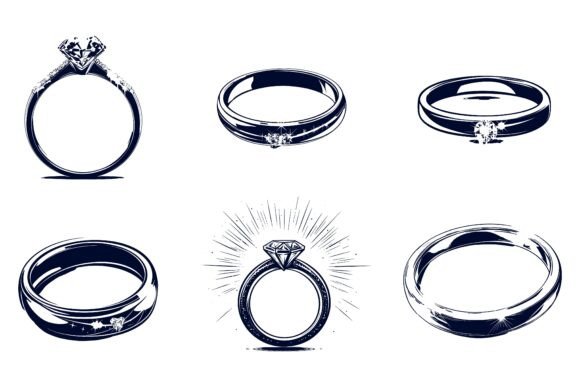
Diamond Engagement Ring Illustrations as Strategic Visual Assets
Every visual touchpoint you create tells a story about your brand, your client, or your message. When the subject is as emotionally charged and detail-oriented as a diamond engagement ring, generic clip art or poorly executed graphics can undermine trust, weaken a campaign, and erode the perceived value of what you are offering. High-quality, editable vector illustrations offer a practical way to stay agile, consistent, and professional without depending on custom photoshoots or expensive design retainers every time you need a new asset. Understanding what makes a well-built diamond engagement ring illustration set valuable—and how to deploy it intentionally—can save hours of production time and support stronger visual communication across multiple channels.
Why a Thoughtfully Built Illustration Set Matters
The difference between a generic image and a carefully organized diamond engagement ring illustration collection often comes down to structure, editability, and visual nuance. Many designers and marketers reach for stock imagery that looks polished at first glance but becomes problematic once you try to adapt colours, isolate elements, or resize content for both a large-format print piece and a mobile app icon. A properly layered AI EPS file changes that workflow entirely.
When you work with a file that maintains neat layer organization and logical grouping, unexpected edits become manageable. You might need to change a stone’s hue to match a particular gemstone offering, adjust the band’s metal tone to align with a product line, or remove a background element to make the ring icon function as a navigational symbol in an app interface. A set designed with Mac and Windows users in mind, and supplied in both native vector and JPG formats, removes friction across team environments and software ecosystems. This kind of preparation may seem technical, but its strategic benefit is deeply practical: it lets you keep your project moving without rework, freelancer delays, or compromises in visual quality.
Understanding the Core Use Cases
Not every brand needs a diamond engagement ring illustration on a daily basis, but for those who operate in jewellery, bridal consulting, luxury gifting, or wedding planning, visual consistency across platforms is non-negotiable. Here are several practical scenarios where a dedicated vector set adds measurable value:
- E-commerce product pages: Use refined iconography to highlight ring features—setting type, carat size, metal options—without overwhelming the product image itself. Detailed but minimal vector accents can improve scanning and comparison.
- Social media storytelling: Create cohesive templates for Instagram, Pinterest, or Facebook campaigns where the diamond engagement ring symbol acts as a recurring visual motif, reinforcing brand recall without repetitive photography.
- Bridal app interfaces: Editable ring symbols serve as intuitive category markers for ring builders, wishlists, or sizing guides. The ability to change colours rapidly helps with dark-mode and light-mode variations.
- Print collaterals: Look-books, brochures, and in-store signage benefit from crisp vector graphics that do not pixelate at large sizes, preserving a high-end feel that complements the main jewellery photography.
- Infographics and educational content: A jeweller might illustrate the anatomy of a ring—prong, girdle, pavilion—using a simplified vector style that stays clean when placed next to dense text.
Each of these applications relies on the fact that you can edit the illustration so easily according to your needs. That flexibility is not a luxury; it is a strategic requirement when you need to adapt one core asset into dozens of tailored variations across digital and physical formats.
When to Reach for a Ready-Made Collection Instead of Custom Design
Custom illustration has its place, but it often involves longer timelines, higher upfront cost, and communication back-and-forth with an artist. A pre-built diamond engagement ring illustration set, especially one that emphasizes perfection in details and consistency across icons, can fill an important gap in your planning. Consider choosing a ready-made collection when:
- Deadlines are tight and you need production-ready files today, not next week.
- Your internal team lacks the specialized vector illustration skill but is comfortable making colour and minor shape adjustments.
- You need a systematic set of icons that share a unified stroke weight, corner radius, and aesthetic so that multiple graphics look like part of the same family.
- You are testing a visual direction and prefer to iterate quickly using adjustable source files rather than commit to a costly custom style guide before validation.
In these situations, a well-organized illustration set functions as a scalable foundation, not just a one-time decoration. You can still add your brand’s personality by editing line thickness, swapping colours, or combining elements—but you skip the drafting phase that often consumes the first several hours of a project.
Planning Your Visual Communication with Long-Term Results in Mind
Many teams treat graphics as isolated tasks: a blog header, an Instagram post, a PDF guide. A more strategic approach looks at how a single illustration style can thread through all these touchpoints to make the overall brand more cohesive. A diamond engagement ring illustration that appears in an email signature, a website favicon, a warranty card, and a YouTube thumbnail creates familiarity. The human brain recognizes repeated visual language, which builds trust and speeds up information processing.
To get that kind of long-term value, pay attention to the file formats and layering structure before you commit to a collection. For example, AI EPS files preserve mathematical paths instead of fixed pixels, so they remain crisp from a business card to a billboard. Well-named layers let you toggle elements like sparkle effects, shadows, or internal facets without hunting through hundreds of unnamed objects. JPG companions offer quick previews and ready-to-post social versions. This combination of vector source and raster convenience supports both high-production design work and fast everyday marketing tasks.
Also, think about the scope of your future projects. Suppose you start by using the illustration for a website hero graphic but later decide to launch a ring configurator tool. If the original file allows you to isolate the band, the stone, and the setting with minimal effort, you can repurpose those assets in an interactive prototype without starting from scratch. That kind of forward compatibility turns a simple purchase into a reusable resource.
Potential Pitfalls and How to Avoid Them
Even a high-quality diamond engagement ring illustration set can lead to disappointing outcomes if it is used without intent. One common mistake is simply dropping complex vector art into a webpage without optimizing the SVG export for performance. A heavy vector file can slow down load times, especially on mobile connections, which hurts user experience and SEO. Always optimize paths and remove unnecessary points when exporting for web use.
Another risk is stylistic mismatch. A hyper-realistic diamond vector may clash with a flat, minimalist brand system. Before integrating any asset, ask whether the level of detail, line quality, and shading align with your existing visual identity. Fortunately, the ability to modify the icon so easily means you can often reduce complexity or change colour palettes to bring the illustration into harmony with your brand guidelines. However, if the fundamental drawing style is too far from your desired look, even extensive editing may not close the gap. Assess a sample or preview carefully to confirm aesthetic compatibility.
There is also a risk of overuse. An icon loses its power when it appears in too many places without variation. Use the diamond engagement ring graphic where it adds meaning—to denote a specific product category, to lead the eye to a ring sizing tool, to reinforce a trust signal. Avoid scattering it decoratively across unrelated sections. Intentional placement respects the audience’s attention and keeps the symbol meaningful.
Making the Most of Editable Layers and Customization
The real power of a well-built AI EPS set lies in the freedom to adapt. Here is a practical workflow example: imagine you launch a seasonal campaign featuring rose gold engagement rings. You open the master file, locate the layer group for the band, select all relevant paths, and apply a warm copper-pink gradient that matches your campaign palette. You then adjust the stone’s facets to a softer brightness to mimic morning light. Within minutes, you have a campaign-specific graphic that still belongs to the same illustration family.
This kind of agility supports A/B testing in digital advertising, too. Run one ad variant with a classic platinum band and another with a two-tone design, both derived from the same source file. Track engagement data to see which visual resonates more with your audience. When you are not limited by rigid, flattened images, your creative testing becomes faster and cheaper.
For infographics, the ability to change colors on the fly means the same ring icon can represent different metals or gemstone types without needing separate illustrations. This consistency in form but variation in colour helps viewers compare options at a glance, a subtle but effective cognitive aid.
Choosing a Set That Aligns with Professional Standards
When evaluating any diamond engagement ring illustration collection, look beyond the preview images. A truly useful product communicates what is under the hood: file formats, compatibility, and organization. The inclusion of both AI EPS and JPG indicates an understanding of diverse design ecosystems. Mac and Windows compatibility might sound like a basic requirement, but surprising gaps exist in poorly prepared products. A clear statement that the files are neatly organized, with thoughtful layer structure, signals that the creator took care during construction. That care translates to less time wasted on your side.
Perfection in details and consistency matters especially when you place multiple icons side by side. Imagine a comparison table featuring a solitaire, a halo, and a three-stone ring. If each illustration has slightly different line weights, shading angles, or perspective, the table looks unprofessional, not because of the design concept but because of inconsistent execution. A set that values uniformity while still allowing individual detail brings reliable professionalism to your materials.
Also consider the versatility for both print and web. A well-built vector file handles CMYK and RGB colour spaces without breakage. You can output press-ready PDFs and retina-ready PNGs from the same parent document. That dual-purpose nature makes the investment efficient, especially for small teams juggling both digital marketing and physical branding.
Integrating the Illustrations into a Broader Content Strategy
A diamond engagement ring graphic can become a small but potent part of a larger educational or sales narrative. For a jewellery store blog, use the icon to break up long-form buying guides, signalling a new section about setting types or diamond grading. For a YouTube channel, stylized vector ring graphics can appear in lower-thirds and end screens, creating a consistent channel identity without complex motion graphics.
In e-learning or staff training modules for retail associates, simple diamond engagement ring illustrations can replace photographs where exact product depiction is less important than teaching concepts like symmetry, proportion, or the four Cs. Because the vector is clean and distraction-free, learners focus on the core information.
This intentional use of illustration supports E-E-A-T (experience, expertise, authoritativeness, trustworthiness) signals in subtle ways. When your content demonstrates visual polish alongside accurate, helpful information, visitors perceive your site as more credible. The polish itself isn’t a ranking factor, but the user experience improvement, lower bounce rates, and higher engagement that can result often correlate with stronger performance over time.
Making the Decision to Invest
Buying an illustration set should be a deliberate step, not an impulse purchase. Ask yourself: What projects on my roadmap require consistent ring imagery? Do I have the in-house capability to edit vector files, or do I need extremely straightforward file structures? How many hours am I currently spending on workarounds, searching for disparate icons that never quite match? When you identify concrete pain points, you can evaluate whether this specific collection solves them.
The promise of being able to modify the icon so easily according to your needs only holds if you and your team are comfortable with basic vector editing. Fortunately, even a modest proficiency with software like Adobe Illustrator or Affinity Designer goes a long way. If your team lacks that skill entirely, consider pairing the purchase with a short internal workshop or a few templates that already incorporate the edited illustrations. This upfront planning ensures you unlock the full value instead of letting a capable asset sit unused.
Finally, factor in the hidden cost of not using a dedicated set. Inconsistent visuals can confuse customers, make your social feed look disjointed, and increase the cognitive load on your audience. Over time, that erodes brand equity in a way that is hard to measure but easy to feel. A well-organized diamond engagement ring illustration collection helps you avoid that slow erosion by providing a reliable visual anchor you can count on.
Whether you are refining a bridal brand, building a jewellery e-commerce interface, or crafting educational content around gemology, the right vector tools act as force multipliers. They give you back time, preserve quality, and let you focus on strategic storytelling instead of pixel-pushing. The files themselves are just paths and fills, but when chosen with purpose and used with intention, they become a quiet yet powerful part of your visual communication system.